


The Cromorama Broadcast Colour Management Glossary defines three reference white levels for HDR: diffuse white, specular white and graphics white. Each one does a different job.
1. Diffuse white: the anchor
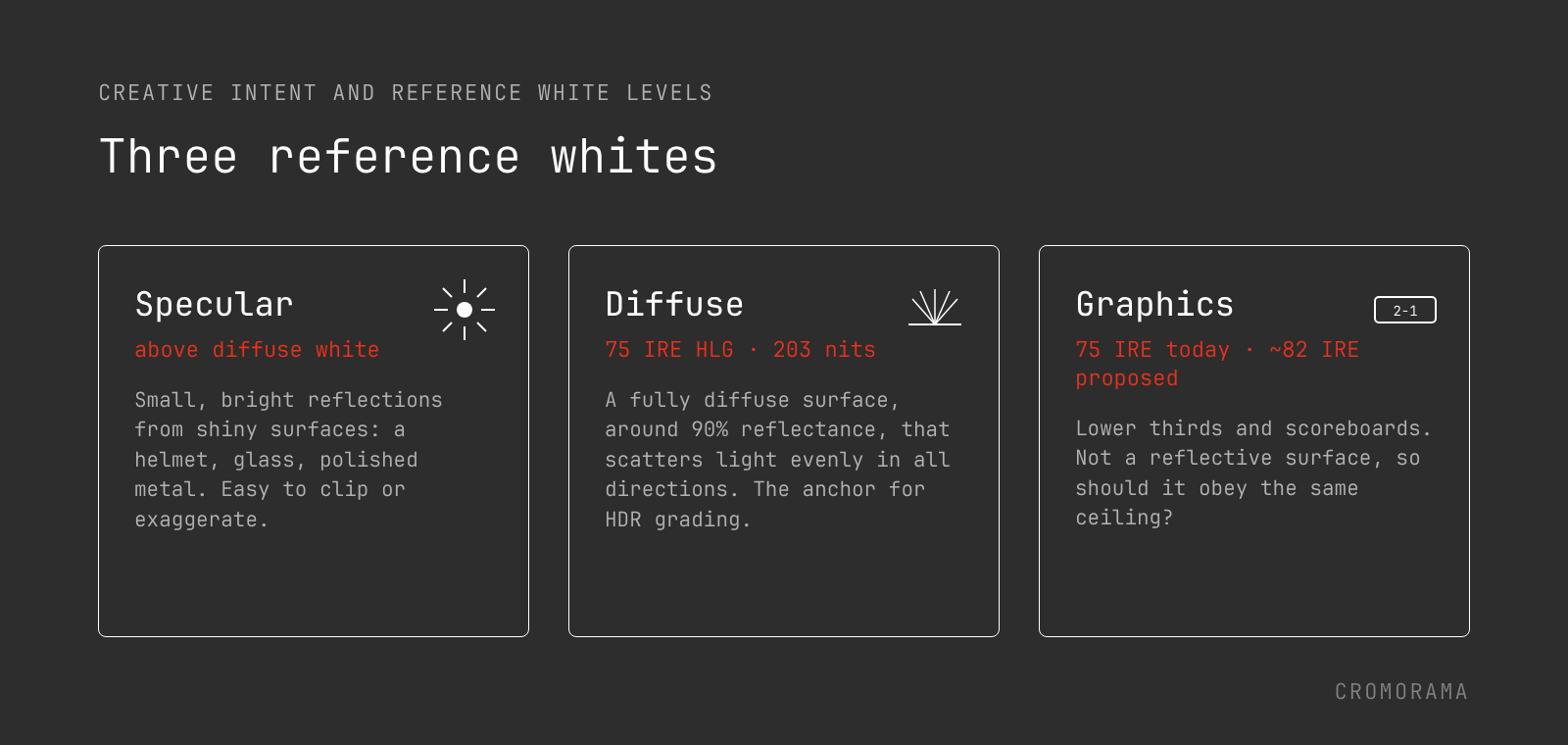
Diffuse white is the white level of a Lambertian, or fully diffuse, non-specular surface: one that scatters incoming light evenly in all directions rather than reflecting it in a concentrated direction. It is generally defined at around 90% reflectance in linear light terms.
It is the primary reference white used to anchor HDR grading and monitoring. It corresponds to 75 IRE in HLG and 58 IRE in PQ, both equal to 203 nits on a 1,000-nit reference display.
2. Specular white: the highlights
Specular white is the level of the small, bright highlights and reflections that come from smooth, shiny surfaces in a scene, such as a helmet, glass or polished metal. Specular highlights sit above diffuse white.
They are one of the more difficult elements to represent correctly. They are naturally very bright and very small in area, so they are easy to either clip or exaggerate.

3. Graphics white: the open question
Graphics white is the maximum white level assigned to on-screen graphical elements such as lower thirds and scoreboards. Current ITU convention sets it at the same level as diffuse white, generally 75 IRE in HLG.
This convention has been challenged in professional practice: graphics are not physically diffuse, reflective surfaces at all, and do not need to obey the same ceiling as a naturalistic scene element. A proposal discussed for an updated broadcast look-up table package favours a slightly higher graphics white, closer to 82 IRE, for two reasons:
- It more closely matches how bright real reflective materials, such as jerseys and helmets, read in HDR sports coverage.
- It measurably reduces the cumulative signal loss that builds up when content is repeatedly converted back and forth between SDR and HLG.
Why it matters
These levels exist to protect creative intent: the intended look of a piece of content, as conceived by the director, camera shading operator and colourist. Simply matching the numeric brightness of each pixel to a reference display does not, on its own, guarantee that creative intent has been preserved for the end viewer. Placing each white where it belongs is part of that job.
This post is part of our monthly series based on the Cromorama Broadcast Colour Management Glossary. Section: Creative Intent and Reference White Levels.


